






Who drew in the Latza album?
The trail points to Wilhelm “Willi” Hansen of Hamburg. A Norwegian prisoner file and a German membership card give a clear picture of the man. These are the sources, and how they connect.
Solved. The National Archives of Norway have confirmed the finding. Watch the NRK news report.
Researched and compiled by Jonas Berthelsen. The investigation is dated 1 October 2026.
How the name was found
1
The appeal
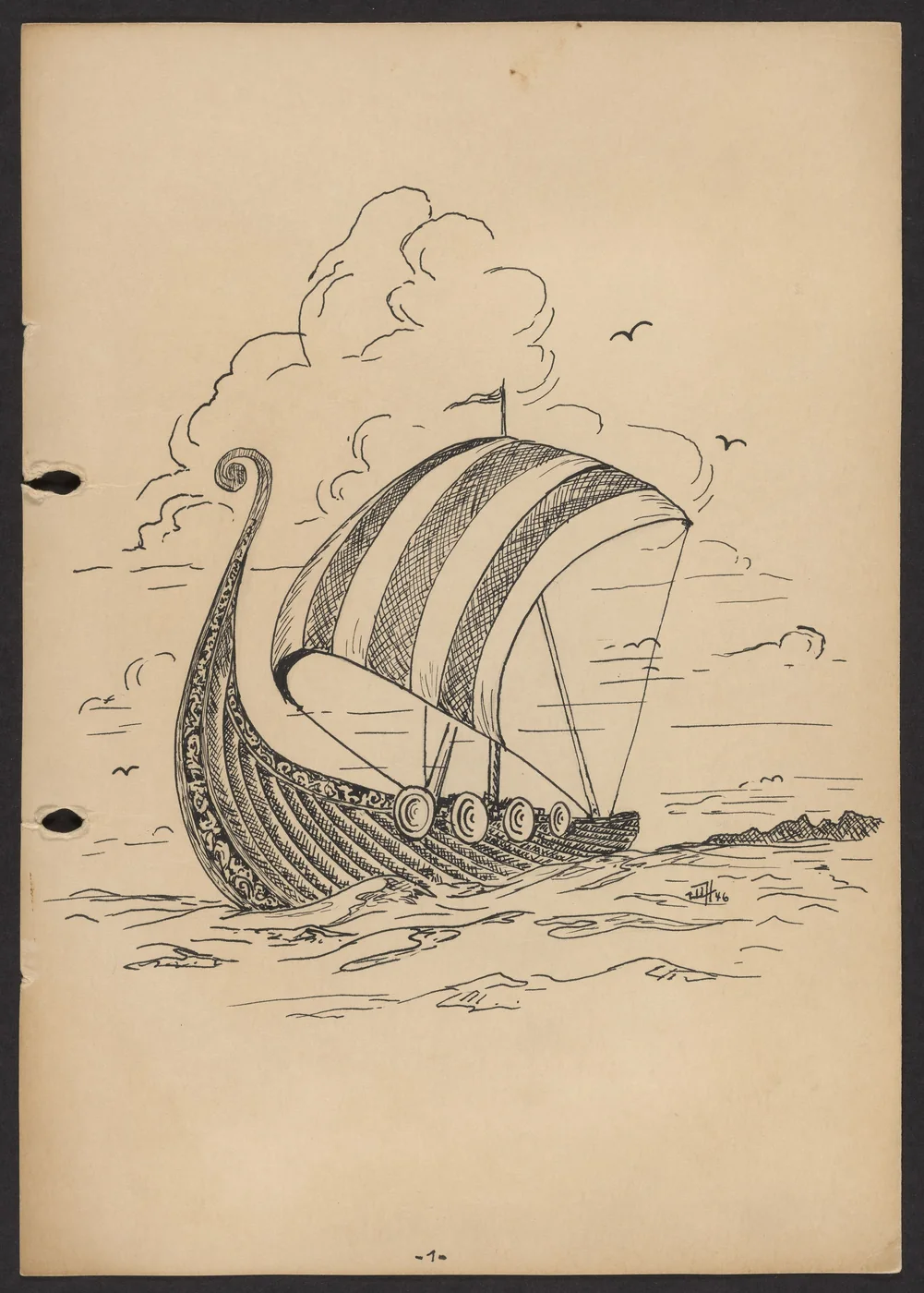
On 8 May 2026 the National Archives of Norway asked for help identifying the artist behind an album that had probably belonged to Hans Latza, an SS judge in occupied Oslo. The album had been digitised, but the signature was hard to read.
Album page 1. National Archives of Norway, AV/RA-PA-2194/U/L0001.
2
The monogram
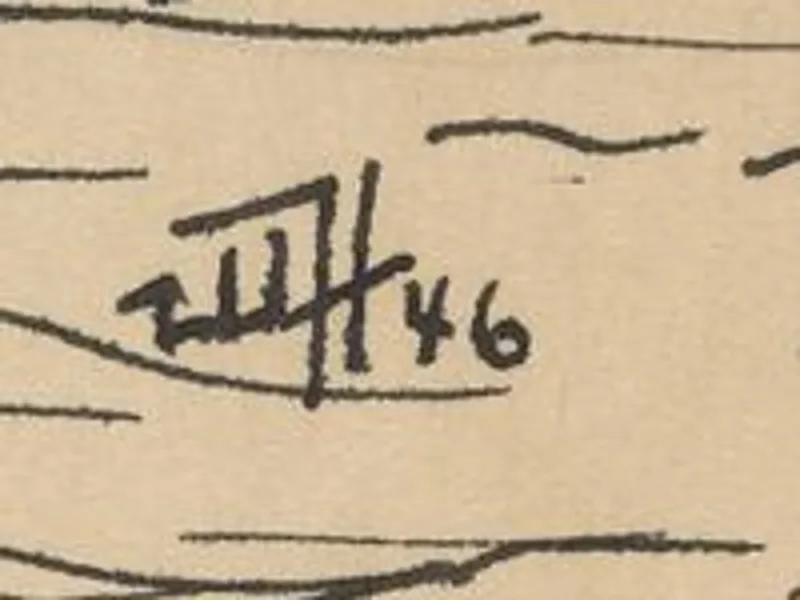
All 111 scans of the album were examined. Beside the Viking ship and beside Borgund stave church is the same monogram, which can be read as “wH”, followed by “46”.
3
The diaries
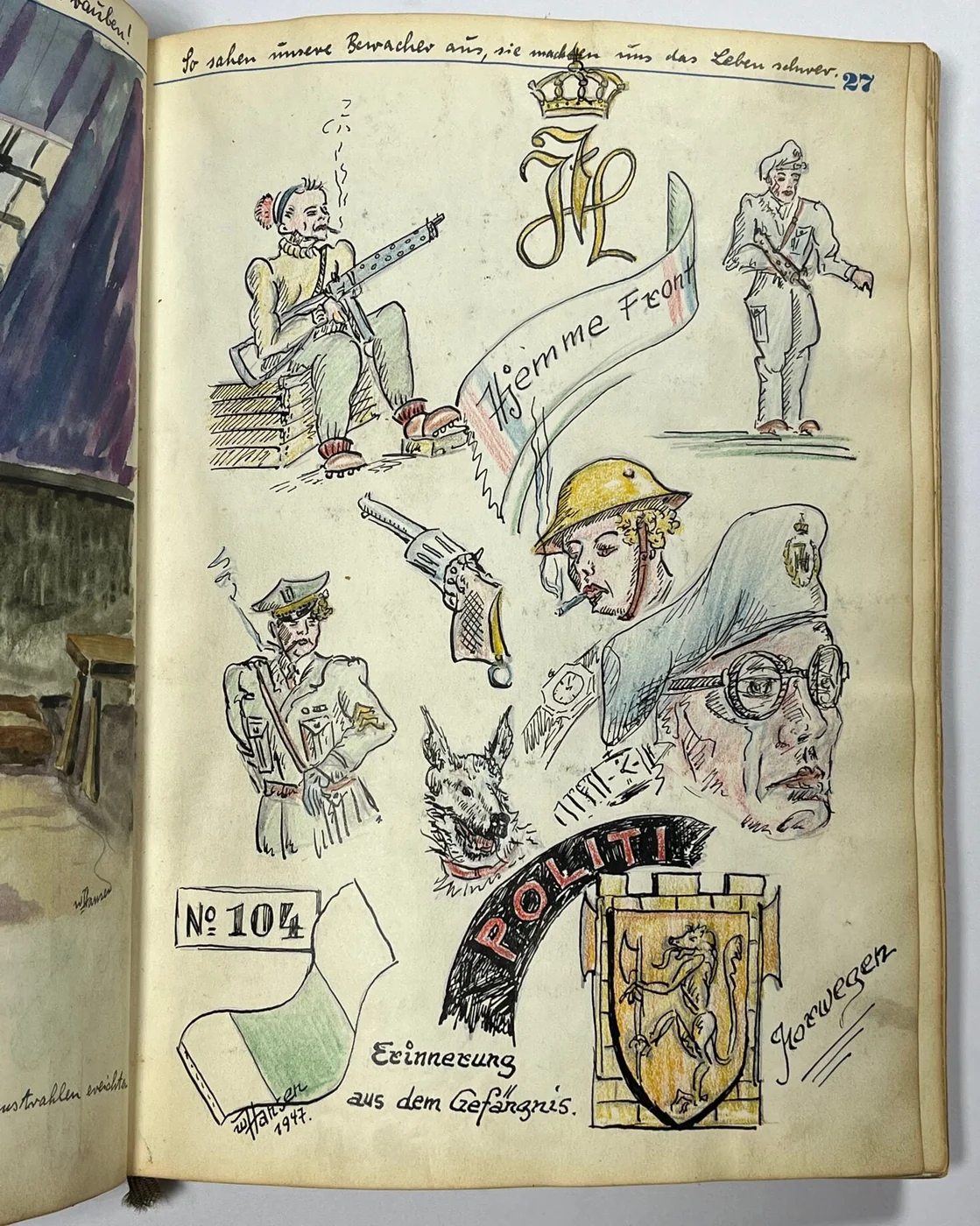
The album also contains drawings from the prison camps after the war. A search for an artist with the initials WH led to three illustrated diaries offered by the rare-book dealer Bookvica. There the name is written out: “W. Hansen 1947”.
4
The prisoner file
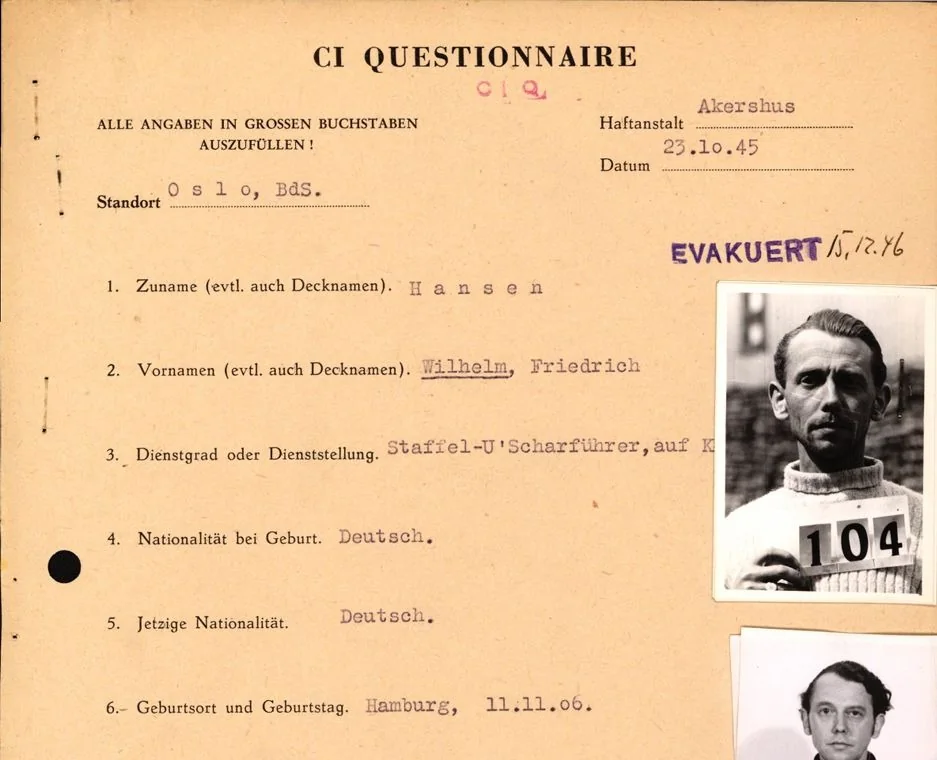
The archive of the Norwegian Armed Forces High Command holds a file on Wilhelm Hansen, a decorator from Hamburg. The photograph shows number 104, the same number that appears on the signed diary page.
5
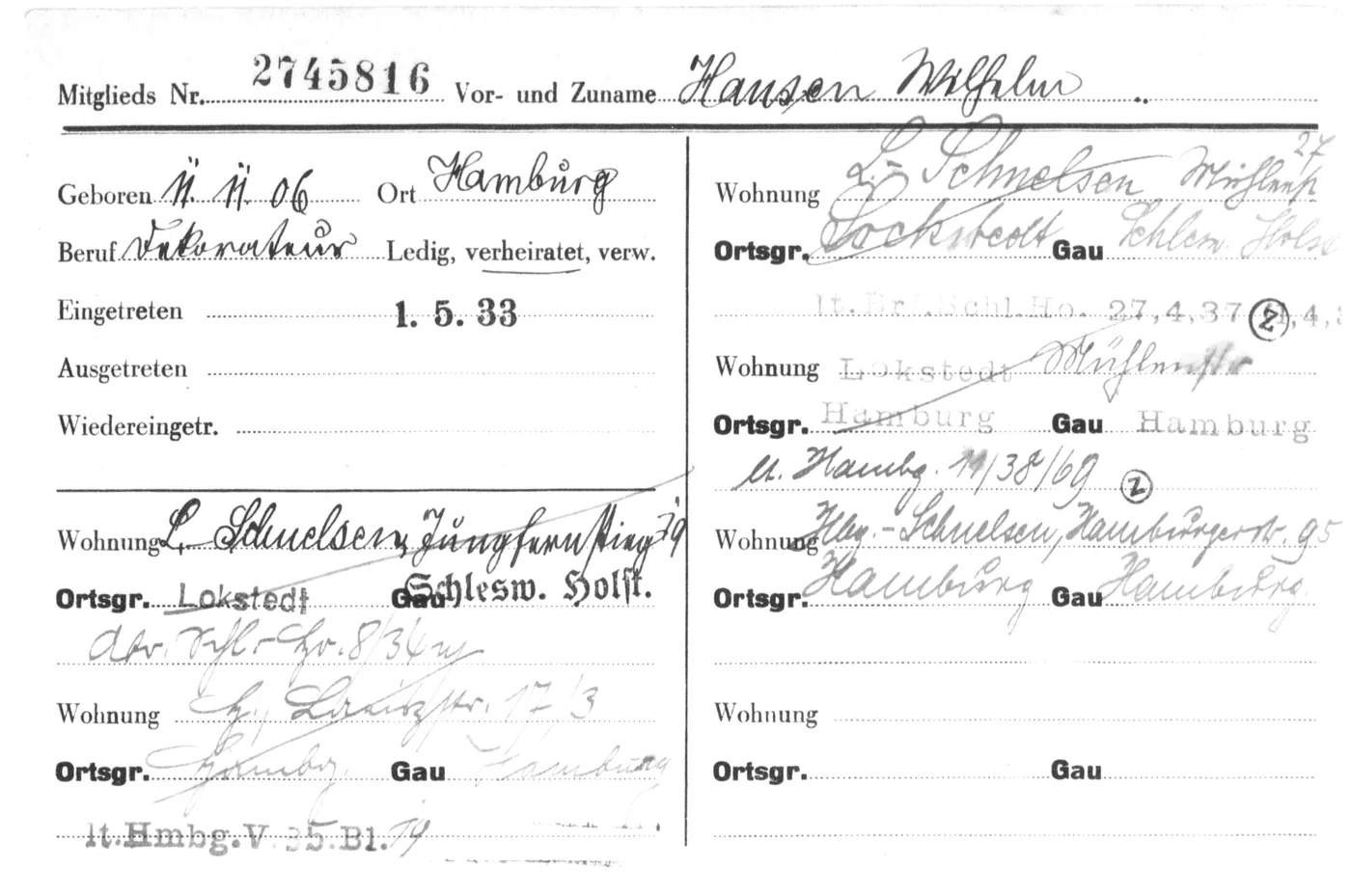
The membership card
Date of birth, occupation and address led on to a membership card held by the US National Archives. The details match the Norwegian file.
NRK Dagsrevyen
The Norwegian public broadcaster NRK reported the finding on its evening news programme Dagsrevyen 21 on Sunday 1 November 2026. The report lasts just under two minutes and begins 3 minutes 15 seconds into the broadcast.
In the report, the National Archives of Norway conclude, in translation: “Wilhelm Hansen is the one behind the illustrations. I think we can establish that.”
The video is loaded from NRK when you select it. The report is in Norwegian.
The signatures
The left column shows the Latza album. The right column shows Hansen’s diaries.
Select an image to see the full source.
- The left stem of the H has a long bar extending to the left.
- The two tall stems are crossed by a rising stroke.
- In the short signature, the small w sits under the bar.
The details are cropped and scaled. The strokes have not been retouched. Slant and size vary between the examples.
The line
The way of drawing also supports the connection. Borgund stave church in the album is signed with the monogram and “46”. Etterstad in the diary is signed “Wilh. Hansen 1947”. Both build up buildings and terrain with small, repeated pen strokes.
Roofs and shadows
The roofing is suggested with many short, curved marks, and denser strokes darken the shadows. Borgund has more horizontal roof marks and tight cross-hatching. At Etterstad the roof marks are more vertical and the wall shadows more open.
Stone walls and grass
In both, the stones have angular, rounded outlines with a few strokes inside. Around the walls stand short, upright grass strokes together with scattered, flat marks on the ground.
These features are consistent with the same artist and support the signature trail. They are also common techniques in pen drawing. The comparison alone therefore does not prove that the drawings are by the same hand.
This is a visual comparison of two signed drawings, not an expert attribution. The details are shown at different magnifications, without retouching.
Prisoner number 104
In the diary, “Nº 104” appears on the same page as the signature “W. Hansen 1947”. A photograph in the file on Wilhelm Friedrich Hansen also shows 104. The form is dated Akershus, 23 October 1945.
The number does not stand alone. The name, Hamburg, the trade of decorator and the stay at Akershus in 1945–1946 also match. Together this gives a very strong identification of the diarist as the man in the file.
The link to the Latza album still rests on the signature comparison and the timeline.
Who was Willi Hansen?
Wilhelm Friedrich Heinrich Hansen trained as a decorator, later became a prison guard and served at Grini, the German prison camp outside Oslo, from May 1943 until the capitulation. After the war he was himself held at Akershus Fortress.
- 1906Born in Hamburg. The date of birth appears both in the Norwegian file and on the German membership card.
- 1923–1928Trained as a decorator, according to the British interrogation report.
- 1928–1936Worked as a decorator in Hamburg.
- 1933Joined the Nazi Party (NSDAP) on 1 May. He gave May 1933 himself on the form from Akershus.
- 1936–1939Employed by the Hamburg tramways. The report describes him as a tram conductor.
- 1939–1943Guard at the State Police prison at Fuhlsbüttel in Hamburg.
- 1943–1945Transferred to Oslo and Grini in May 1943. According to the police letter he first worked on provisions and later supervised the workshops.
- 1945–1946The diary dates the start of his captivity to 25 May 1945. The file documents Akershus in October 1945. Drawings show cells and a studio.
- 1946The file is marked “Evacuated 15.12.46”. The diary describes the crossing to Hamburg and onward transport to Sandbostel.
- 1947Several diary pages are signed this year. The date of release, later address and date of death have not been found.
The form also lists parents, wife and children. They are not reproduced here.
The membership card
The digitised Nazi Party card index held by NARA contains a card for Wilhelm Hansen, born in Hamburg in 1906, a decorator, who joined on 1 May 1933. The card also has a later address that appears in the Norwegian file. The combination gives a strong link to the same man.
The machine-read text of the name index provided the lead. The details have been checked against the scan. The remaining relocation notes on the card have not been fully deciphered.
What the documents say about the war
The file contains serious information. An English translation of a letter from the Norwegian Chief of Police dated 19 March 1946 reproduces witness statements that Hansen beat and kicked prisoners at Grini and took food and tobacco from parcels sent to them.
This is information reproduced in case documents, not a judgment. The same letter states that the Director of Public Prosecutions agreed that no further steps should be taken on the Norwegian side, and that Hansen could be returned to Germany. The information was passed to the Allied authorities at the same time. The letter does not document an acquittal.
A British interrogation report dated 14 May 1946 also summarises accounts of brutal treatment of prisoners, and sets them against Hansen’s own claim that he treated the prisoners well.
The documents use the rank Staffel-Unterscharführer. The police letter states explicitly that he wore SS uniform at Fuhlsbüttel without being a member of the SS. Party membership, uniform and formal SS membership must therefore be kept apart.
What can be concluded?
Update, 1 November 2026: the National Archives of Norway stated on NRK Dagsrevyen that Wilhelm Hansen is behind the illustrations. The text below is the assessment as it stood on 1 October, before that statement.
Wilhelm Hansen is a strongly supported candidate for the drawings carrying the WH monogram. The connection rests on the form of the signatures and on historical details that match. Similarities in the drawing technique add further support.
Bookvica’s catalogue places Hansen at Akershus from May 1945 to September 1946. Trandum.no describes Latza’s imprisonment at Akershus from the summer of 1945. They may therefore have been in the same place in the period the album’s “46” points to. That does not prove that the men met, or that the drawings were made in the prison.
There is still no direct statement that he drew in the album. Not all the unsigned drawings have been assessed individually.
What is still missing
- A document stating explicitly that Hansen drew in the Latza album.
- The complete diaries, in particular identification pages, the stamp and any mention of Latza.
- The original witness interviews behind the police case, and the follow-up by the Allied authorities.
- Internment and any denazification file in Germany, with a release date and later address.
- A documented life after 1947, a date of death and any other works.
Archive searches
The investigation covers Norwegian, German, British and American sources. The overview separates documents that have been read, catalogue searches without a certain match, and archives that require further access.
- Digitalarkivet, Armed Forces High Command IIFound and readPrisoner file with questionnaire, photographs, British report and police letter. AV/RA-RAFA-3915/D/Db/L0011/0037, scans 519–526.
- NARA, Nazi Party card indexFound and readMembership card found and checked against the original scan. The right card is identified by name, date, occupation and address.
- Digitalarkivet, repatriated GermansSearched, no certain matchTables of contents and selected cards examined. The whole index has not been gone through.
- National Library of NorwaySearched, no certain matchSearches on the name with Grini and Fuhlsbüttel, and in the Grini book. The excerpts were too short for a certain identification.
- Hamburg University Library, address booksSearched, no certain matchThe 1950 volume has been read. No entry is linked with certainty to the man born in 1906.
- The National Archives, United KingdomSearched, no certain matchThe Discovery catalogue was searched for the name, Grini and Sandbostel. No certain personal file found.
- Deutsche Digitale BibliothekSearched, no certain matchA document titled “Hansen, Willi” concerns a local branch in Brandenburg. Without a matching date of birth it has not been used.
- Staatsarchiv HamburgNot readThe catalogue of the denazification archive has been checked. No personal file has been read.
- BundesarchivNot readMembership index and cases from the British zone courts. No certain case has been found for Hansen.
- Sandbostel memorialNot readThe archive description for the civilian internment camp 1945–1948 has been examined. No personal file has been read.
- Neuengamme / FuhlsbüttelNot readA possible source for Hansen’s service in Hamburg. No personal document found in open searches.
- Arolsen ArchivesNot readThe Sandbostel collection concerns a different period from Hansen’s internment.
The absence of a match does not mean the archive holds nothing. Many names exist only inside scanned or undigitised files.
Sources
- The National Archives’ appeal, 8 May 2026 (in Norwegian)The starting point for the investigation and the album’s probable connection to Latza.
- The Latza album in DigitalarkivetArchive reference AV/RA-PA-2194/U/L0001. The Viking ship is scan 3, Borgund is scan 24.
- Bookvica: W. Hansen, item 1657Photographs of the diaries and catalogue details. The catalogue’s information should be checked against the originals.
- Trandum.no: Chief judge Hans Latza (in Norwegian)Petter Aunaas and Dag Leraand, 2023. Used to check Latza’s imprisonment and timeline.
- The prisoner file: questionnaire from Akershus, 23 October 1945Armed Forces High Command II, AV/RA-RAFA-3915/D/Db/L0011/0037, scans 519–524.
- Letter from the Chief of Police, 19 March 1946English translation in the same file, scan 526. Ref. 854/46, case 1009.
- British interrogation report, 14 May 1946Same file, scan 525, signed F. Marsh, Sgt.
- NARA: Wilhelm Hansen’s Nazi Party membership cardRG 242, A3340-MFOK-H0002, frame 02486, top card.